

A Trauma Therapist’s Low-5 Session: When the Fight Stops
My body has rehearsed the same defensive loop for years. In a StepWise Low-5 session with a trusted colleague, the fight finally stops — and something softer becomes possible.
By Bree F., LMFT
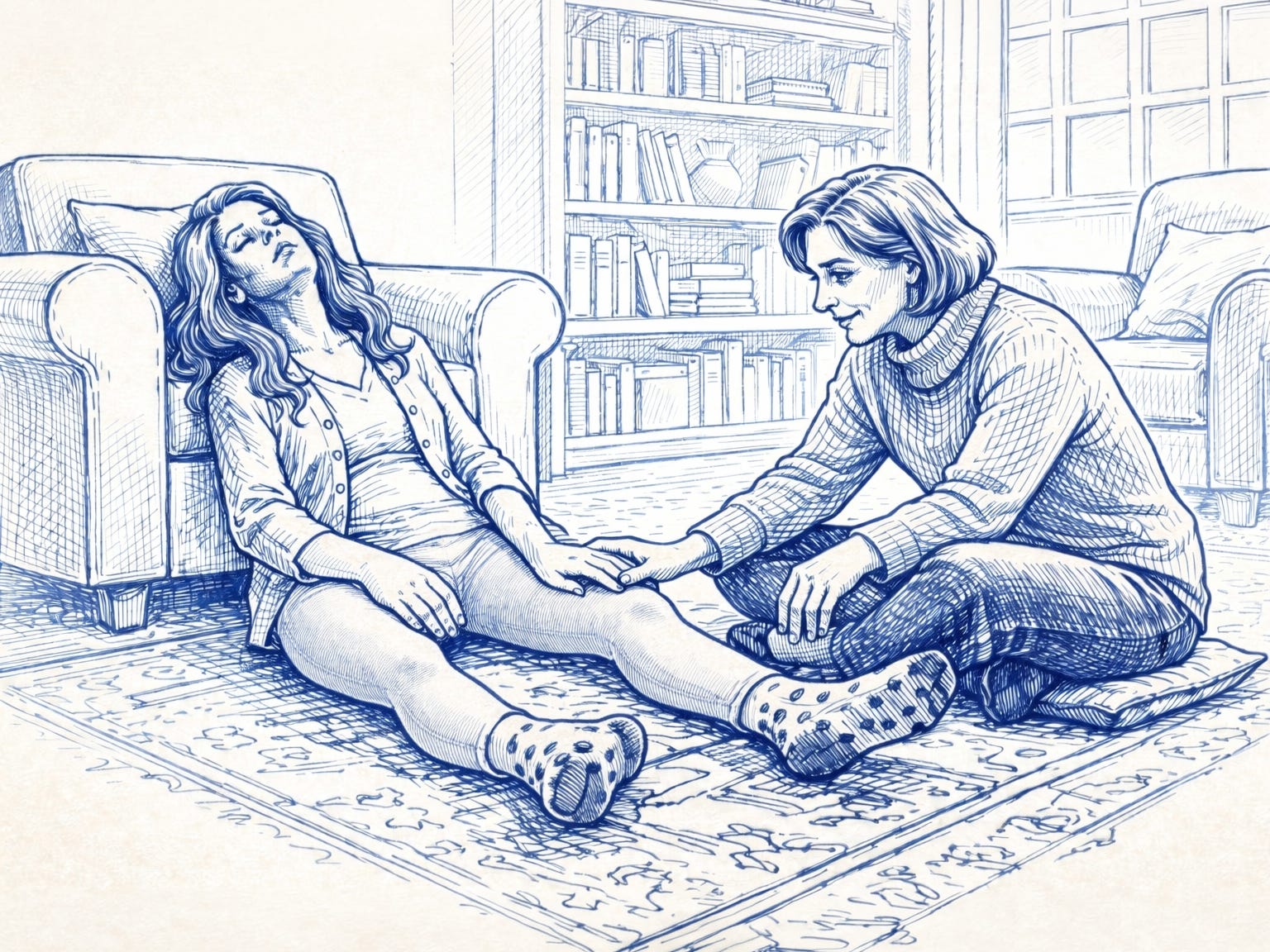
Please note: Names have been changed to protect confidentialityJamie and I met at Psychedelic Somatic Interactional Psychotherapy (PSIP) training at the Psychedelic Somatic Institute. PSIP is a relational, body-based trauma therapy where the therapist is an active, attuned participant while the client’s nervous system works through stuck protective patterns.
By the time we met for this session, we knew each other well. We had each named something uncomfortable in our own medicine work: a kind of looping.
For me, the loop had a very specific signature. During our PSIP sessions, my arms would jerk out defensively, and my shoulders would brace. My body would move as if it were trying to fight its way free, but the fight never completed. I would go into activation and then cycle, again and again, without resolution.
I did not always have a story for it. Later, I learned the likely scene of the crime: an extended hospitalisation when I was an infant, where I was strapped down. Pre-verbal. Not memory in the usual sense, but something my nervous system seemed to know.
What made it stranger is that I had met this pattern on other medicines, including ketamine and MDMA. The startle-fight would come, and I would work with it, sometimes getting a little traction, but I could not stay on the other side of it.
With high-dose 5-MeO-DMT, I had never touched it at all. The doses I had taken were high enough to bypass body memory completely. Powerful, yes, but too fast, too total, and the dose blew me past the stage where the pattern lived.
Low-5 with the StepWise protocol appealed for practical reasons. The effects are short-acting, I could titrate, I could pause, and I could stop. I suspected I might finally be able to reach what I had been circling for years: the sadness underneath the fight.
Jamie agreed with that framing. She said she had seen versions of this in clients: the system keeps trying to get free and cannot, and the work is often about letting the person reach the helplessness underneath the fight, instead of endlessly rehearsing escape.
Build a container that does not chase intensity
We set up in a way that felt almost deliberately unremarkable: seated comfortably, vape pen in hand, time available, no need to rush. Jamie was close enough that I could feel her as a steady presence, but she was not doing anything to me, and that mattered.
There was an implicit agreement that we were not there to manufacture a dramatic arc. We were there to make contact with a pattern, slowly enough that my system could register what was happening.
I started with the lower-dose pen. One measured inhale, a short hold, then exhale.
Within seconds, my arms flicked outward, small, jerky movements like brief electrical bursts. It looked like a startle, but it was not only being startled. It was defensive and organised, more like fighting against being strapped down than reacting to a sound.
I recognised it immediately. The infant hospitalisation was not a memory I recalled in the way you recall a childhood scene; it arrived as movement. I had only learned the details later, from my parents and siblings, but under a light dose, my body seemed to know exactly what it was doing.
Jamie tracked it without seizing it. Later, she said my system looked like it was trying to break free of something, and that it showed up in my body right away.
Stay low on purpose, to keep choice online
I did not go up in dose immediately, because that was the point of StepWise. I wanted the sensations to show themselves without forcing them into intensity, and without turning activation into a performance.
I took another inhale on the lower-dose pen and stayed right there. The pattern continued: brief bursts of movement followed by stillness. A pulse of fight, then quiet, and then another pulse.
I could feel how easily I could have pushed past it. I could have chased the heat, sought more, and treated intensity as evidence of progress, but I stayed with contact instead. I wanted my body to find its rhythm without rushing.
Jamie maintained presence without narrating or interpreting. She simply stayed close, calm, and available, which created a felt sense that I was accompanied while still being the one inside the experience.
Increase the dose only when the body is ready
When I switched to the medium-dose pen, the somatic charge deepened. The jerks became more pronounced in my arms and shoulders, insistent, like a trapped animal testing the bars.
Something else appeared alongside the fight. It was not despair exactly; it felt more like collapse, the thing my nervous system has historically treated as death.
I could feel the choice point. I could stop, and I knew I could stop, which changed the whole equation. It was not a heroic endurance test; it was a paced investigation, and my agency was built into the pacing.
At the same time, I sensed that if I stayed with it, I might fall into something I had rarely let myself feel: the sadness underneath mobilisation. Later, Jamie described it as a threshold, and said I was right at the edge, still fighting, but close to dropping into helplessness.
Let collapse be an event, not a philosophy
After another inhale on the medium pen, the shift happened quickly, not as an insight, but as a bodily event. The jerks stopped, and my body softened in a way that felt involuntary, like the fight mechanism finally ran out of fuel.
I collapsed backward and slightly to one side, head supported, eyes closed. It did not feel like surrender as a choice; it felt like my system giving out. In spiritual language, people sometimes call this surrender, but for me, surrender implies agency, and collapse does not.
It was not ego death. It was closer to my body, letting itself die, in the specific, terrifying way my early nervous system learned to equate helplessness with not surviving. This is where relational safety became the difference between re-traumatising and resolving.
Jamie moved closer. She offered gentle contact, stroking my hair and placing a light touch on my back, and I could feel that she was tracking me without trying to steer me.
That contact mattered because it helped my system register a new association: this is helplessness, and I am not alone. And in that, I did something I have rarely been able to do, which was to stay.
Find the sadness underneath the fight
In the collapsed state, I found myself in what I later called an island of sadness. It was quiet and heavy and real, and crucially, it was not death.
That difference was everything. The sadness was intense, but it did not come with panic. I could be inside it and still be here, and my system’s old equation, collapse equals death, simply did not come true.
Another difference was relational. In my original imprint, helplessness meant isolation, but here Jamie was present. Just there, and I could feel comforted rather than abandoned.
It was not that the feeling was diluted. It was that the context was different, and that difference seemed to be part of what allowed the sadness to be survivable. Jamie later said she could feel the shift in her own body as well, as if my system had finally landed where it needed to go.
Let “enough” be the outcome
When the wave passed, I stayed in a low-arousal stillness for several minutes. My breath was slow and steady, and my body did not need to perform anything. What surprised me most was the sense of enough. I did not feel pulled to prolong the state or wring meaning from it, and the fact that it happened at all, that I could access sadness without terror and remain there, felt almost magical in its simplicity.
I also saw clearly that I do not think I could have gone there alone, because there was something about the safety of Jamie being there, and about her understanding my pattern, that made it possible for my system to collapse without fear.
Afterwards, Jamie said she could tell I had gotten what I needed, even though the session did not stretch on. My system had gone where it needed to go, and then it came back on its own.
Notice what changes when life resumes
In the days after the session, I noticed something subtle but significant: access. The sadness was still there, but it was not an emergency, and it did not trigger the familiar startle-fight loop.
It felt grounded, almost like weather moving through, rather than a storm that required defence. I found myself calling it helpful moroseness, which sounds odd, but it is accurate, because it was not depressive collapse. It was contact, and it was sadness that did not need to be escaped.
Even after travel and busyness, when I slowed down again, I could return to it and feel gratitude, not dread. After a year of naming and working around the loop in PSIP, getting to the other side, even if that other side was sadness, felt like relief.
StepWise mattered here. The gradual titration meant I had agency at every point, and I knew I could stop, and that knowing changed the nervous system equation. The short-acting waves made the work feel navigable rather than overpowering.
Jamie reflected that what I had now was not only catharsis in the moment, it was an emotional state I could revisit. That felt true, and something about my baseline had changed, not because the sadness vanished, but because I could enter it without immediately mobilising to fight my way out.
Leave room for what is still unfinished
I am not claiming I am done. I do not think early, wordless imprints resolve that neatly, and I do not expect a single session to complete a story that began before language.
But something important shifted. The fight no longer feels like the only doorway, and there is another place I can go now, a place that used to read as death and now reads as sadness: survivable, human, and held.
And for me, that is not a small change.
Stay With the Work
Gathering reports like Bree's takes time, and your sharing of her story really helps our cause. Thanks for sharing.
This really resonated with me. The way you describe staying low enough to keep choice and contact online, and letting the body find its own pace into what’s underneath, mirrors a lot of what I’ve been exploring lately. Thank you for putting this into words.
Beautiful share! Thank you so much for speaking to your process so vulnerably and honestly🌿🙏🏻