

1984: Introducing the Mac, Tetris, and the Toad
A peer-reviewed paper dates the 5-MeO-DMT toad tradition to a 1984 zine. No older psychedelic toad tradition is to be found.
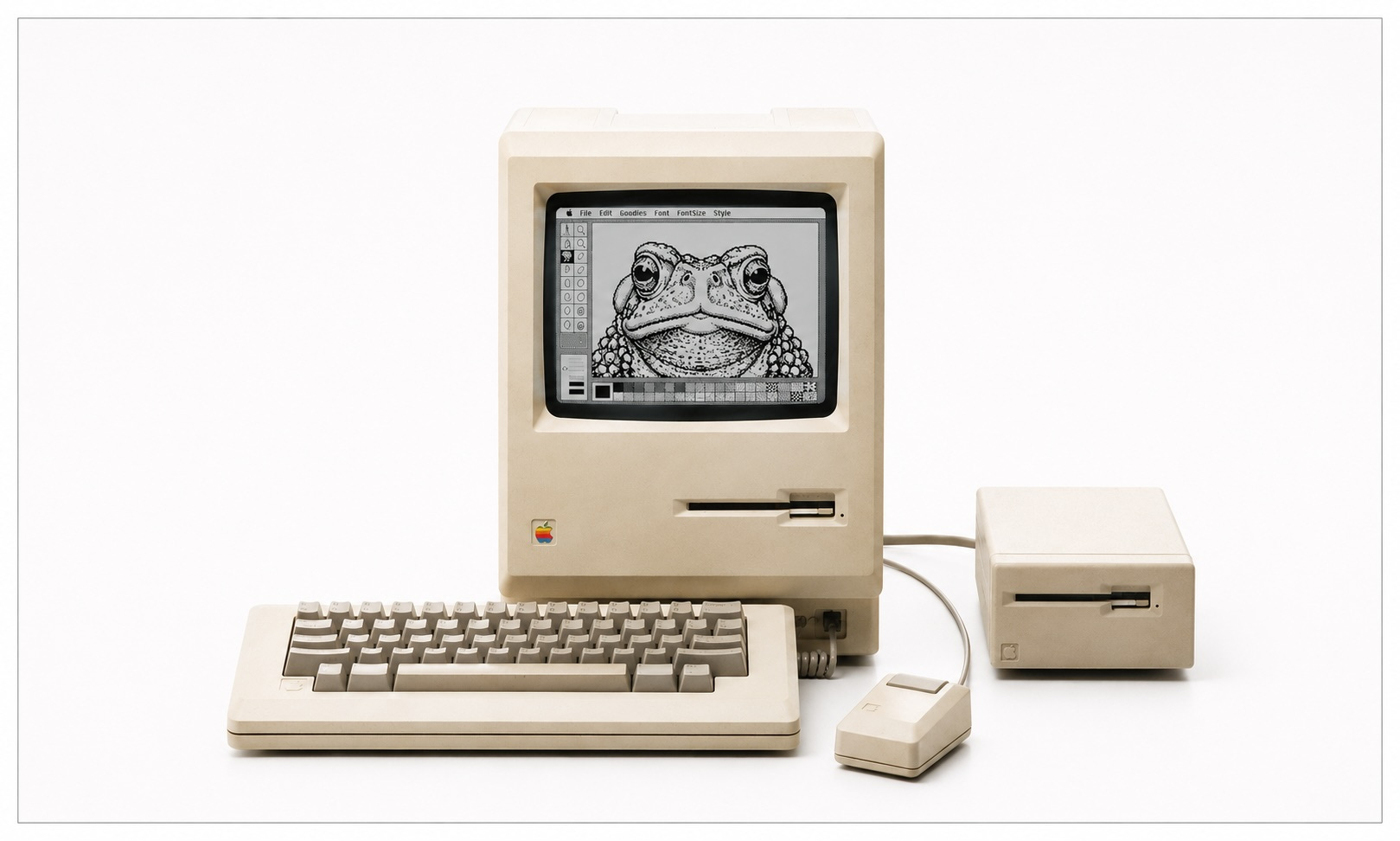
5-MeO-DMT, the short-acting and powerful psychedelic that many people know simply as “the toad,” is increasingly in the spotlight. And yet very few people could tell you whether it belongs to an ancient tradition, the way peyote does. The mescaline in peyote turns up in the archaeological record more than five thousand years ago. In contrast, 5-MeO-DMT has no such record, and yet there is a sense that something old sits behind it, and that a desert toad is somehow involved.
Most people are curious to know more because the instinct to respect tradition is a good one. But is the tradition ancient, or new?
A paper published this spring in Psychedelics, titled Fabricated ancestrality: The Sonoran Desert toad, psychedelic globalization, and the ecological politics of 5-MeO-DMT, set out to answer exactly that. Ana Maria Ortiz Bernal, Charles Raison and their colleagues searched the ethnographic and historical record for evidence of traditional ceremonial use of the Sonoran Desert toad, Incilius alvarius (long known as Bufo alvarius), and the secretion it produces.
They found no record of a toad tradition older than 1984.
And the history matters ecologically. 5-MeO-DMT can be synthesized in a lab, molecule-for-molecule identical, without a single toad. Unfortunately, the belief in an “authentic,” ancient ceremony bound to the toad’s secretion drives real ecological harm. A wild desert toad is caught and its glands squeezed until they empty, again and again, to supply a global market seeking authenticity.
A Lineage, Just Not The Right One
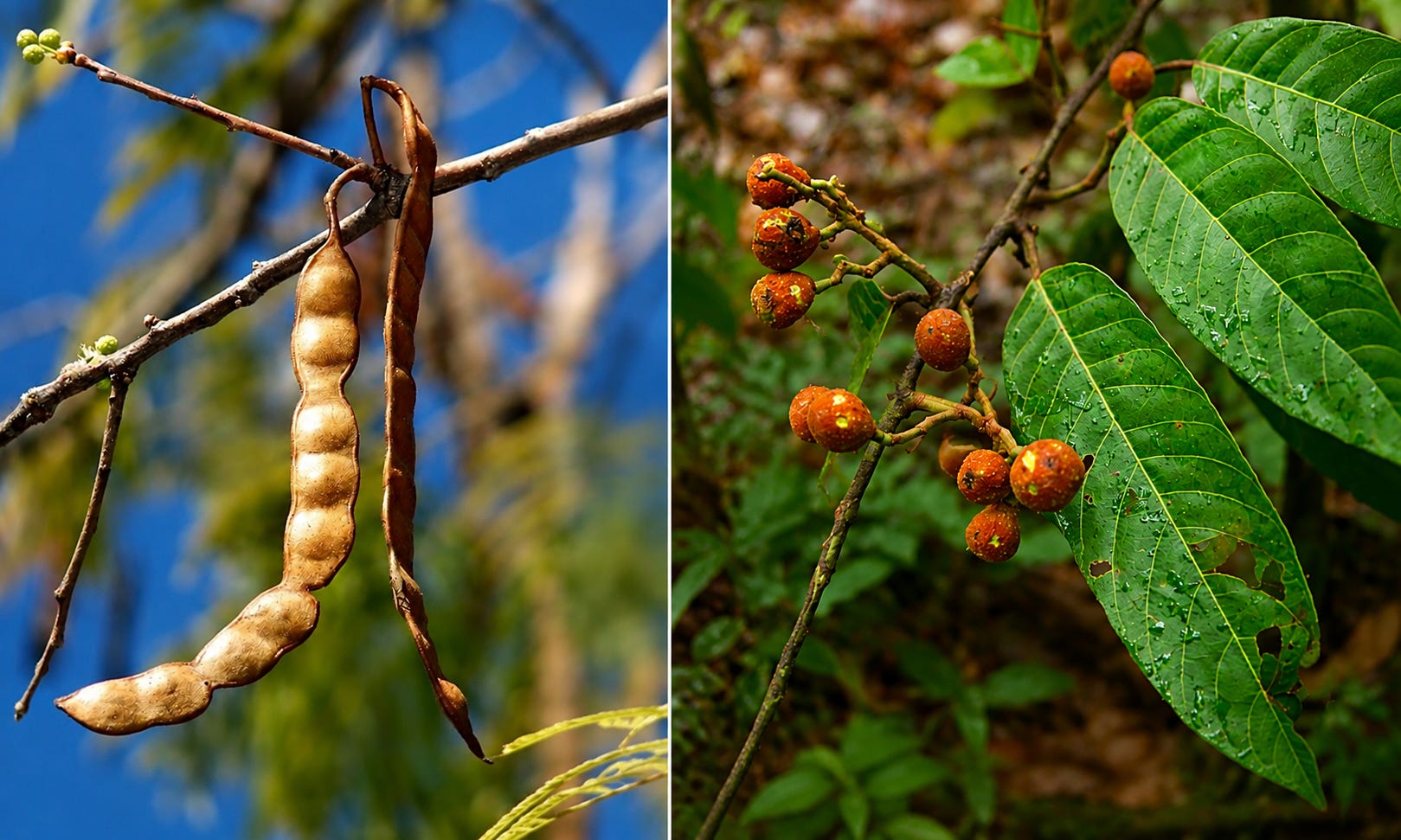
5-MeO-DMT does have documented traditions, and they run through plants. Across South America, Indigenous communities have prepared snuffs from yopo seeds and Virola resin for at least five centuries. The archaeological record of Anadenanthera snuff use runs back to 2,000 BCE.
These snuffs are blown up the nose, a slow route, and their chemistry varies. Yopo carries only a trace of 5-MeO-DMT, a fraction of a percent. Virola is richer, around eight percent 5-MeO-DMT, though it varies widely from plant to plant. The toad’s secretion is a different thing entirely: up to around fifteen percent pure 5-MeO-DMT by weight, by some analyses higher, smoked rather than sniffed. The plants carried the molecule. It’s unlikely they ever carried the intensity of today’s high-dose Toad tradition.
1984: Say Hello to the Mac. And the Toad?
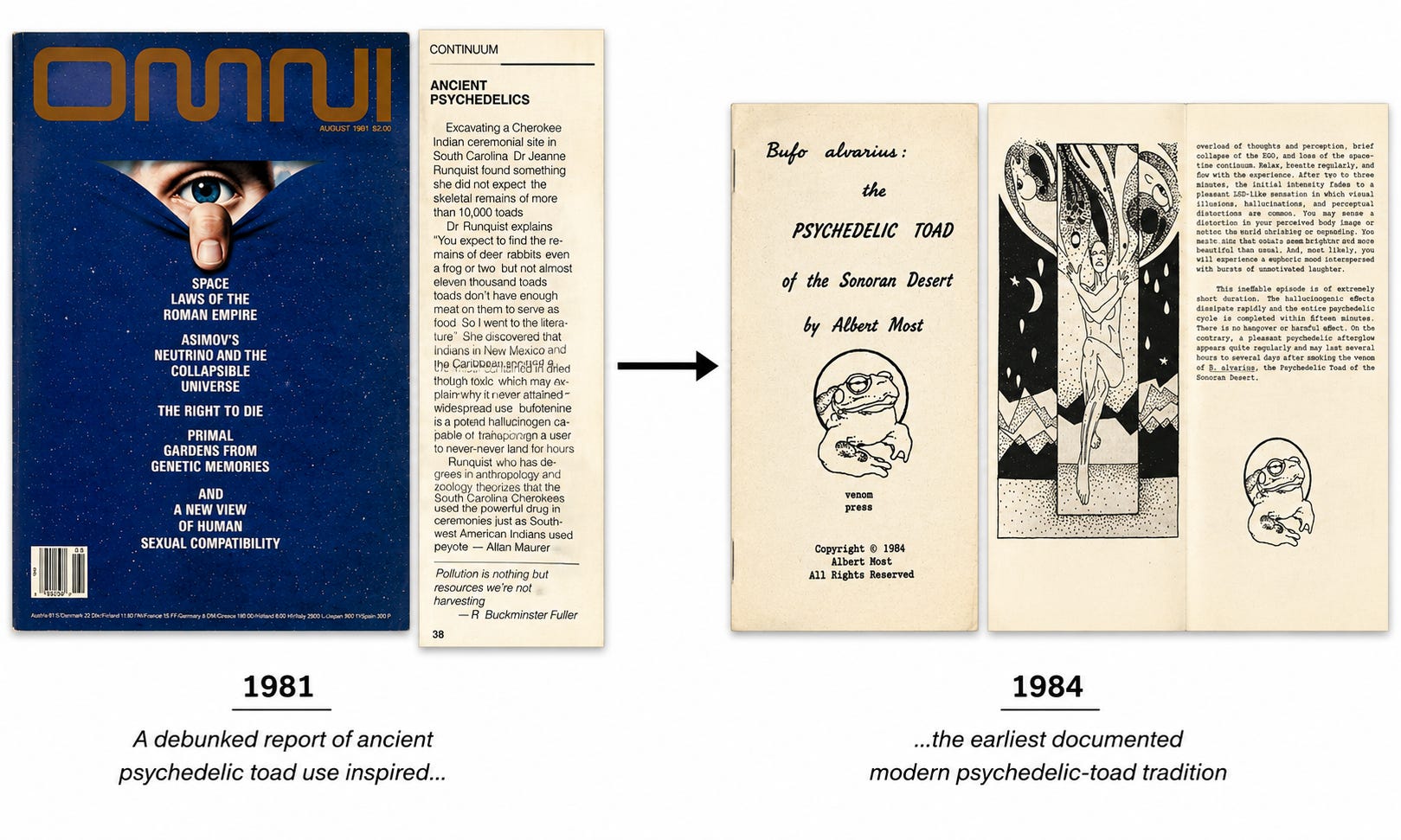
January 1984: Apple aired the ”1984” TV commercial, considered by many to be the most famous commercial in television history, and days later the first Macintosh computers were for sale. In June, the programmer Alexey Pajitnov created Tetris at a computer lab in Moscow. And somewhere in the same year, with no keynote and no fanfare, the toad tradition was published too. Its founding document was a zine.
The author was Ken Nelson, writing as Albert Most. He was inspired by an August 1981 Omni article about a Cherokee archeological dig that had turned up a trove of toad bones. Without any evidence, the article speculated that the toads may have been part of a psychedelic ritual involving toad skin. Acting on the idea, Nelson drove out to the Sonoran Desert in the summer of 1983, after the seasonal rains had brought the toads out. Near Gila, Arizona, he caught a live toad and squeezed its glands until the venom squirted onto a glass plate; dried and smoked, a piece the size of a match head produced immediate effects. He wrote it up, and in 1984 Venom Press published it as a zine: Bufo Alvarius: The Psychedelic Toad of the Sonoran Desert.
Nelson hadn’t discovered the molecule. Chemists and psychonauts had been experimenting with synthetic 5-MeO-DMT since the 1960s. What he had done was tell people how to take it straight from the toad, and what it felt like when they did: “an onset of almost overwhelming psychedelic effects,” a person “completely absorbed in a complex chemical event,” a “brief collapse of the EGO,” a “loss of the space-time continuum.” His set-and-setting notes end, “Enjoy your trip!” That little pamphlet launched the toad into the psychedelic underground.
What about the Toad Bones?
Here is the objection almost everyone raises.
That Omni magazine archeological dig report was real, and the speculation had teeth. If the ancient world really left caches of toad bones behind, then perhaps there was a lineage after all, lost to the record rather than never there.
But the researchers point out that the best-known toad bones in the archaeological literature are the wrong toad. The Mesoamerican caches, from Olmec sites such as San Lorenzo, belong to Bufo marinus, the cane toad, whose secretion carries bufotenine but almost no 5-MeO-DMT. And a closer 2005 re-analysis concluded even those deposits were most likely natural rather than the residue of any ritual. The toad that actually makes 5-MeO-DMT is Incilius alvarius, the Sonoran species, which lives hundreds of miles north and appears in no ritual record at all.
There is a deeper reason the ancient idea does not hold, and it is pharmacological. Swallowed, 5-MeO-DMT does very little, because the gut inactivates it before it reaches the brain. It works most potently when vaporized and drawn into the lungs, which is exactly what Nelson’s pamphlet describes. The heat, the pipe, the single held breath: none of it has a known precedent before the twentieth century.
So there is an irony at the root of it. The thing that inspired the discovery, an article claiming ancient people had once used the toad, is the very kind of claim the modern practice would later manufacture for itself.
Making It Ancient
For some practitioners, the toad’s missing lineage is part of the appeal. If you are sensitive about appropriating a tradition, a psychedelic that belongs to nobody is a relief. The paper traces the end of this cultural respite to 2011, when a Hermosillo-based foundation, Fundación OTA.C, brought the secretion to a Comcáac (Seri) community at Punta Chueca in Sonora to combat methamphetamine addiction. The claim of ancient Comcáac use was set out in a 2016 book by a facilitator the field has since repudiated. Over the following decade, the practice hardened into a business: field researchers have documented a certification system in which “permits” to administer the toad are issued under the authority of a Seri shaman or council of elders in exchange for a fee, in one recorded case about US$500.
The researchers argue that the name OTA.C reveals the lack of a true lineage. In the Comcáac language, otac is simply the general word for toads and frogs: “a thing that sits on water.” It was capitalized into the name of a foundation, and from there it became the name of their sacrament.
Invented Is Not Fake
A story can be invented and still be true to the people who hold it.
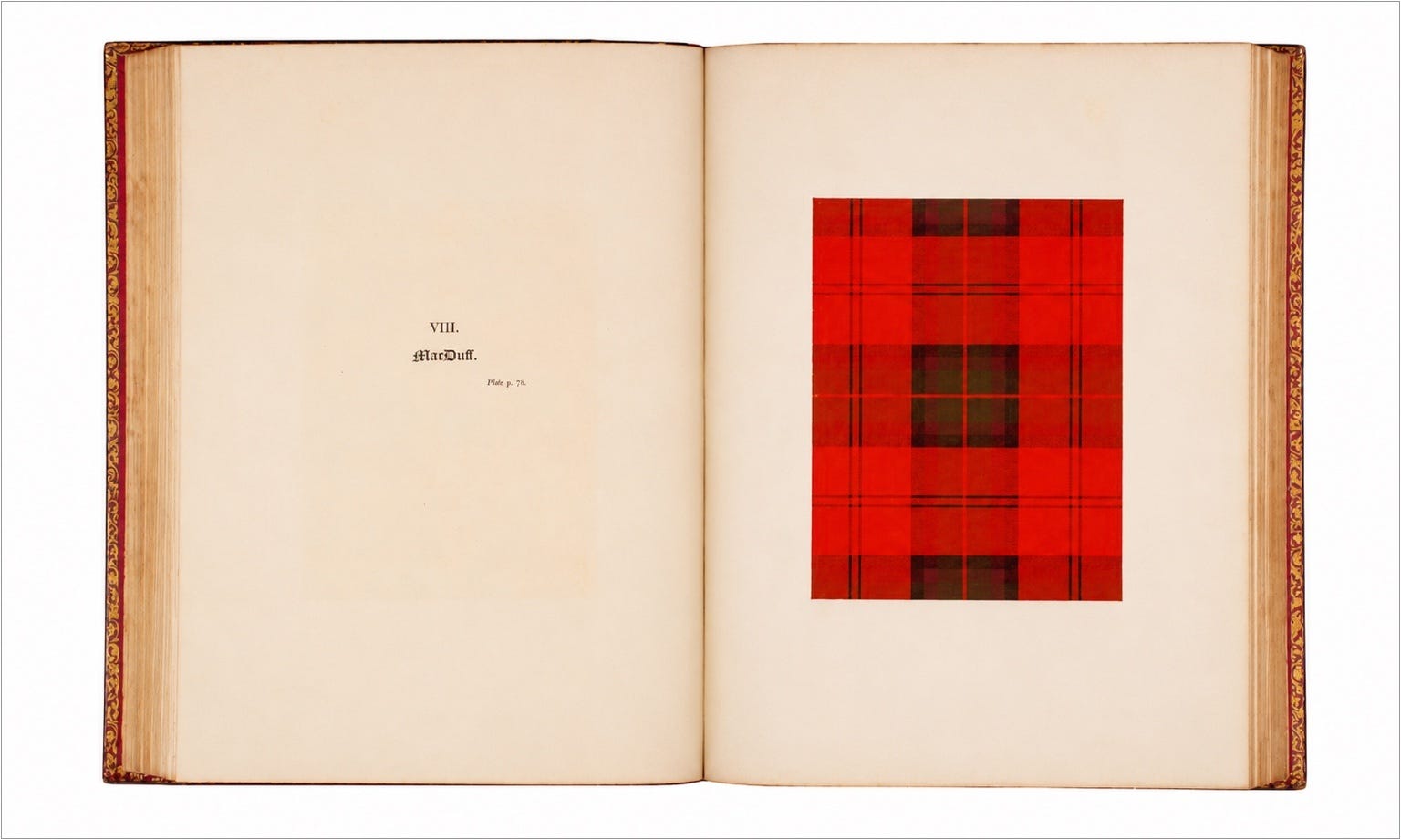
Think of Braveheart, the 1995 film about the medieval Scottish rebel William Wallace. Wallace died in 1305, and the film dresses him in a belted plaid. And yet no Scot wore such a plaid until the 16th century. Clan tartans came later still, largely a 19th-century invention. Walter Scott, the novelist who did more than anyone to popularize plaid, conceded in 1829 that “the idea of distinguishing the clans by their tartans is but a fashion of modern date.”
And yet it would be a crude thing to tell a Scot that her tartan is not a worthy tradition. It means something to her. The meaning is real even where the history is not.
Ortiz Bernal and her colleagues have names for the machinery here. Ancestralization is the process of dressing a recent practice as an ancient one; fabricated ancestrality is what that process produces: a claim of deep lineage with no historical, archaeological, or ethnographic record behind it. Both are critical terms in their telling, and they distinguish this from the organic way traditions genuinely change over time. What they object to is not that a practice is new, but that a false antiquity is manufactured, from outside a community, for a market, to make a tradition saleable. The difference is not the age of the story. It is who built it, and what for.
That line is harder to walk than it looks, and the authors do not pretend otherwise. A story invented for a market can still be taken up in good faith by people who find something real in it, and there is no clean test that sorts the two apart from outside.
It is worth reading Fabricated Ancestrality yourself. It is a careful argument about how legitimacy gets manufactured, and about what a field owes the culture and the creature it built a story around.
The Cost to the Toad
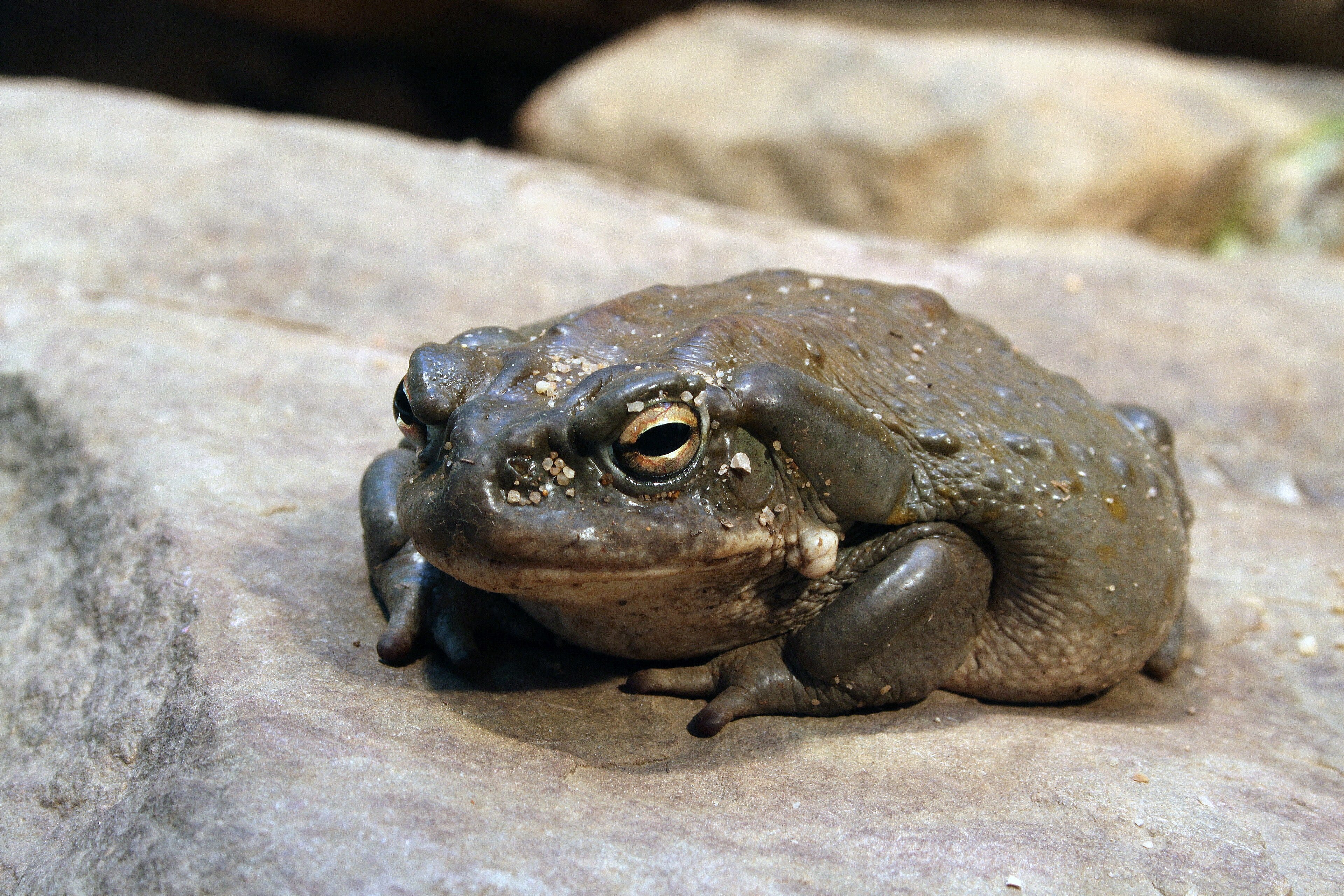
The authors dwell on the ecological cost. Wild Incilius alvarius are caught and milked for a secretion a laboratory can synthesize without them, and because the toad's range is narrow, the pressure falls on a single population. Poaching, captive milking, and a warming climate stress the toads from all sides, while a kilogram of dried secretion can fetch fifty thousand dollars. The paper's warning is blunt:
“The future of 5-MeO-DMT need not depend on the continued extraction of a wild species. Whether the psychedelic field aligns itself with conservation or continues practices that contribute to depletion will shape not only the fate of Incilius alvarius, but the moral coherence of the psychedelic field itself.”
This is the quiet cost of a fabricated lineage. The narrative that toad medicine is “the real thing” — authentic and ancient — is what creates the demand. And because that story is tied to the animal itself, the pressure falls on a single desert population, milked to meet a hunger the story created.
The toad tradition is only a few decades old. That need not make it worthless, because invented things become real all the time. But the reverence was authored recently, by people we can name, and the animal at its centre is not necessary for the tradition. For anyone who wants a genuine lineage, there is one. It runs through plants, it is centuries old, and it asks nothing of the toad.
For the Curious
Thank you for being the kind of reader who wants to know where a story actually comes from. Your support is what keeps this work independent.
But what about the Shakespeare?